General News
11 May, 2025
Anzac Day: Pam Cupper
Pam Cupper addressed Anzac Day service attendees in Sheep Hills, Brim and Warracknabeal as this year's guest speaker.
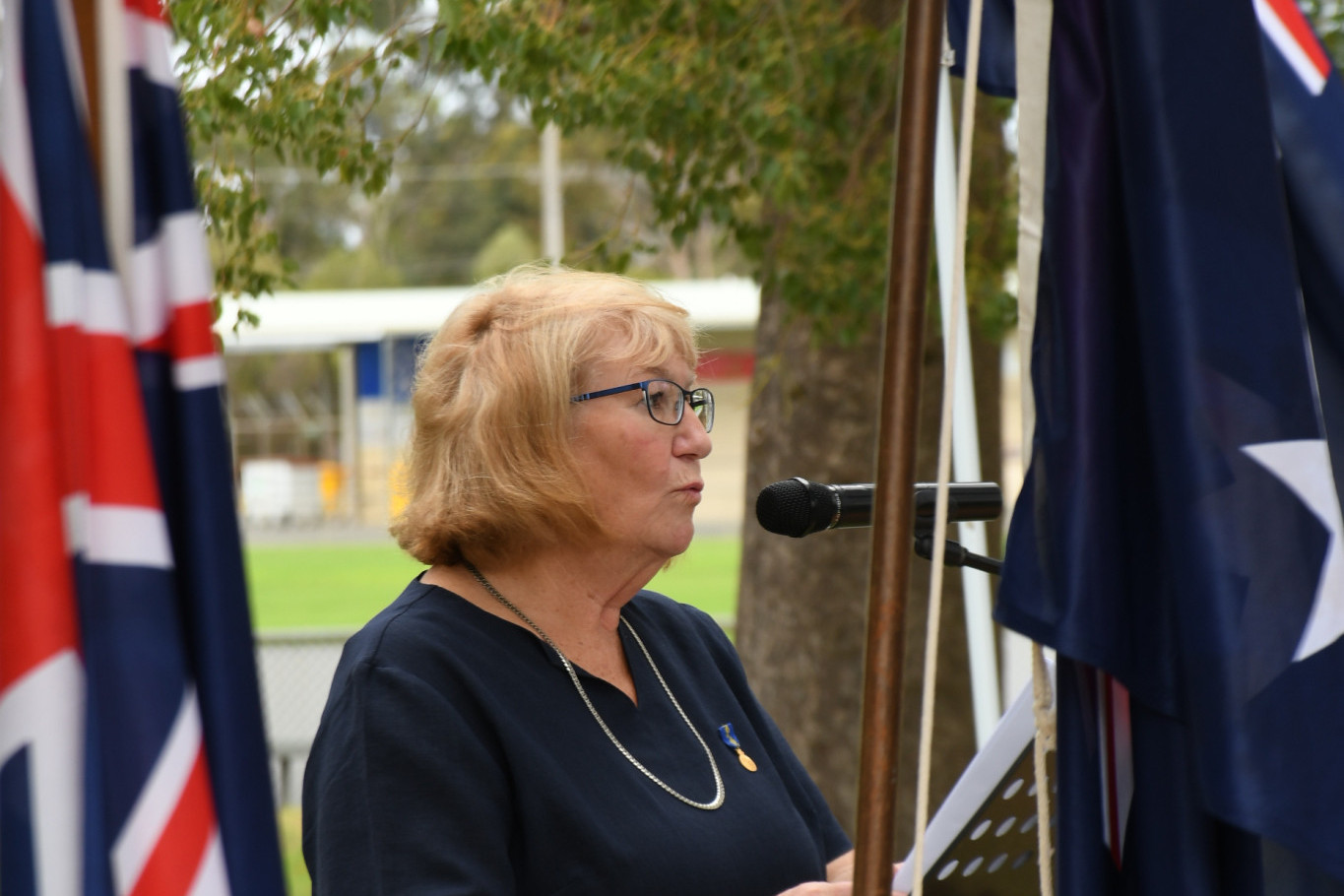
Read her speech in full:
When Graeme invited me to speak, some months ago now, I thought about a theme and began to put some ideas down.
Then, two months ago, I travelled overseas. I spent a few days at Gallipoli, re-acquainting myself with the battlefields.
I was even able to see again the original Lone Pine, remarkably different in appearance to this.
For me at Gallipoli, there's always a sense of "home", it's almost my second home, in total, over forty-odd years, I've spent the equivalent of months there.
But it wasn't so much at Gallipoli that I experienced this sense of home; I went on to Paris, where I was researching something totally unconnected with Australians in World War One.
For a couple of weeks, I heard no Australian voices in the streets as I followed paths of the French Revolution.
Then I learned there was a Commonwealth War Graves cemetery on the edge of Paris.
Many of you are familiar with the Commonwealth War Graves Commission cemeteries - established during and after the First World War, they cover a huge area in northern France and Belgium, where they mark out the former front line of the Western Front.
In my research into Australian military history and leading battlefield tours, I've spent many hours in these beautifully-
maintained cemeteries.
So I ventured out to the City of Paris Cemetery at Pantin.
It's a civilian cemetery, the largest in France, with a million burials.
My Google Maps suggested it was easy to find - but of course it wasn't.
It's now surrounded by high rise apartment buildings, and a school seemed to have been built where the entrance was supposed to be. After what seemed like hours, I found a gate.
One corner of this vast cemetery has been set aside for military burials - so, the French red, white and blue flag flutters over row upon row of French military dead.
Then I saw - the familiar white Commonwealth War Graves Commission stone arch.
I walked into this little piece of Commonwealth ground and ... the first grave in the first row was of an Australian soldier.
An overwhelming homesickness engulfed me.
There were 93 Commonwealth soldiers buried in this little plot; 11 were Australians.
I went along the three rows, looking at each Australian grave: there was no fighting in Paris during World War One, and the Australians buried here had died after the end of the war.
They were part of the force sent into France to clean up, repair, reconstruct after four years of war.
Usually, when I visit a Commonwealth War Graves Cemetery with a group of travellers, we have a little store of poppies in our pockets, and we place these on particular graves.
I didn't have any poppies, but then I looked at the tiny yellow and white daisies that grow in the lawn, I picked these and placed one at the foot of each Australian's headstone.
I wondered how often anyone visited these graves, especially Australians.
So far away - both for me, and for those 11 buried there - an aching for home.
Recently I read a poem that describes the Australian soldiers sense of home, when he's serving overseas, so far away.
It's by Rudyard Kipling, the poet who gave us those immortal words, "Lest We Forget".
His poem, Lichtenberg, was written about an incident in South Africa during the Boer War, when an Australian described the power of scent, or smell, to evoke vivid memories and nostalgia.
Wattles - native to Australia - grow in many other places.
When Australians saw, or more especially smelt wattle in South Africa, it brought
waves of nostalgia, longing for home.
Kipling seems to say that much of the terror of war, "the big things" of war, are often forgotten and
... the little things remain,
Like the smell of the wattle by Lichtenberg,
Riding in, in the rain.
The last verse of Kipling's poem sums it up:
I have forgotten a hundred fights,
But one I shall never forget—
With the raindrops bunging up my sights
And my eyes bunged up with wet;
And through the crack and the stink of the cordite
(Ah Christ! My country again!)
The smell of the wattle by Lichtenberg,
Riding in, in the rain.
There's another poem, this time from World War Two:
David McNicoll was both a soldier and a war correspondent for a Melbourne newspaper - so he knew war. And he knew the draw of home.
His poem, Australian Mail - Palestine - describes Australians in Palestine during the Second World War. A padre was giving a service when, as his poem tells:
'Above the padre's voice we heard
An engine drone ...'
This was the mail coming in. Each man recognised the sound, the engine drone, and as they heard it, each man recalled HOME:
And in the clouds we saw again
Our homes: the noonday shimmering sun
On farm and beach and station run,
The stock knee-high in summer grass,
The shearers nodding as we pass
Each stand; the silos crammed with wheat,
The sheep-dogs panting in the heat
... the verse ends with the line
The aching, taunting thoughts of home.
But we don't have to go to Rudyard Kipling or David McNicoll to find this theme.
A powerful description comes from just here, from a man grown up in Warracknabeal and Minyip, Bangerang and Dunmunkle - your home.
Ernest Robert Newell was born at Minyip, and grew up on his family’s farm nearby.
When war broke out in August 1914, Ern had just turned 19 and perhaps working on the farm seemed more important than enlisting.
Nearly two years later, in May 1916, that had changed.
Ern left Minyip and travelled, probably taking the train to Ballarat, with two mates from the area: Wilf Hewitt and Lyndon – known as Lyn – Vaughan were from Warracknabeal and all three enlisted in Ballarat on 26 May 1916.
They enlisted in the 39th Battalion, a newish unit formed in early 1916 after the great losses from Gallipoli.
The History of the 39th Bn describes how Ballarat ‘adopted’ the 39th, and when the first of the battalion sailed out of Port Phillip Bay, the writer commented, ‘’The 39th Battalion AIF was on its
way to the Great Adventure.’
Ern and his mates arrived in England in November 1916, and sailed to France a few months later.
We know quite a lot about Ern’s experiences in England, France and Belgium because he was a great letter writer.
Just a few of his letters to his brother Fred have survived, and he also put together what he called his ‘Career in France and Belgium’, descriptions of his army service.
They are rich pickings for historians of the First World War.
In February 1917, Ern wrote that he had ‘declared war at last’, and had just spent nine days in trenches on the Western Front.
He wrote that ‘things in general are fairly quiet now although they make it a bit warm for a while at times, but if it wasn’t for the big guns, there would be nothing to break the monotony of the affair.’
It was, however, as the History of the 39th Battalion recorded, ‘a lull before a storm.’
In this sector, early 1917 was marked by several raids across no-man’s-land: raiding parties would creep out at night from their forward trenches and saps, to reconnoitre but also, hopefully, to capture a German soldier or two who were then interrogated for vital information about trenches, dispositions and reinforcements.
On the night of 29 May 1917, Ern’s close friend, Lyn Vaughan, was wounded in one of these raids, hit in both shoulders, head and hand. His wounds were bad enough to have him returned to Australia, discharged as medically unfit.
For him, the war was over.
The two remaining great friends, Wilf Hewitt and Ern Newell, were about to really enter the fight.
The Battle of Messines, in southern Belgium, commenced on 7 June 1917, a meticulously-planned assault to begin the Third Battle of Ypres.
Ern and Wilf's battalion attacked on the southern flank.
Ern later described that first day – his and Wilf’s first real battle:
... on June 7th at about 3 o’clock in the morning, the Hell on Earth was loosed.
We struggled up during the night through shell holes and clouds of gas to a forward position where we waited for the barrage to open at 3a.m.
It opened and at the same moment they blew up three or four mines [in all, 19 mines were exploded that morning] ...
Our trenches rocked like a chair.
I can tell you we wondered what had happened for a moment, but we looked over the bags, and there were our lads swarming across no mans land, and in less than 5 minutes prisoners were coming back in droves and this continued all day.
I can tell you we were in our glory. ... all went well and we had reached our objective by
10 a.m. but poor old Wilf was not there, he had fallen just before hand.
[Career, pp. 2-3.]
Wilf Hewitt, close friend to Ern and Lyn, engaged to Lyn’s sister Mildred, was killed in action on the morning 7 June 1917.
His body was not identified and today his name is on the Menin Gate Memorial in Ypres and on the Memorial Gates here.
Success at Messines led on to the August and September battles east of Ypres.
On 4 October, Ern took part in the First Battle of Passchendaele.
In his Career, he described:
... the 1st Passchendaele affair ... was a great success.
We moved forward on the night of Oct 3rd as in Messines and.... we cut him to pieces with our artillery ...
The first attack towards Passchendaele was successful, but a week later, Ern joined the attempt to take Passchendaele itself.
He continued his description in his Career:
.. the evening of the 11 Oct when we again moved forward to do what we call the second Passchendaele stunt ... [the Germans] were too strong for us ... we had to retire ... with him sniping at us, and his machine guns going a treat, there were men falling all round, but I marched on
with the old Lewis gun on my shoulder and came out without a scratch.
[Career, pp. 6-8.]
Ern was really one of the lucky ones.
He enlisted in May 1916 which meant he and his mates had missed Gallipoli, and such disasters as Fromelles in July 1916, and he did not serve in the Battle of the Somme.
He saw his first battle at Messines, where his great mate Wilf Hewitt was killed, and he emerged
unscathed from the two attempts to take Passchendaele.
He served in three major battles in 1917 – that year was by far the worst year for deaths in the
AIF – in those twelve months, nearly 20,000 Australians died – not wounded - as a result of fighting on the Western Front, and the towns and villages of Western Victoria suffered almost unimaginable losses: Warracknabeal had at least 5 local men killed at Messines, and at least 7 at Passchendaele.
Horsham had 25 men killed in First Passchendaele alone!
Ern survived, with nary a scratch.
Throughout his time in England, France and Belgium, Ern remained a son of
the Wimmera.
His letters and his 'Career' resonate with comments about home, the seasons, his ever-growing family back in Minyip and Warracknabeal.
In January 1917 he asked his brother Fred, ‘I suppose you are well into harvest now, taking off about 12 bags to the acre’ – ‘and under’ he wryly added.
A month later he inquired of his new young niece: ‘How is Pearl getting on? I suppose by the time you get this, she will be pretty near able to walk’.
Later he wrote that he’d received a letter from his brother and sister-in-law and ‘was pleased to see that you were all well, and able to go for holidays’.
Clearly there was the perennial mice plague: ‘You must have had some great times catching mice Fred, I can just imagine what they were like.’
In mid-1918, the 39th Bn moved to the Villers-Bretonneux sector and on 18 June 1918, Ern was hit in the stomach, and invalided to England.
His wounds were not considered life-threatening, and he was fortunate to see out the remaining five months of the war at Northampton War Hospital and on furlough in England.
On 11 November 1918, the war ended.
For most Australians, however, it was still a long wait before they could get home.
The 39th Bn, like many other units of the AIF, returned to France to help with reconstruction.
At the same time, the army looked to each soldier's future in Australia.
His letter written in January 1919 describes ‘the main thing to do now, is on this educational stunt, there are lectures every day ...’
Ern described how the Battalion had helped the ‘French kiddies of the village’ celebrate their first Christmas after five years of war.
There were ‘toys and things ... and a bonzer Christmas tree’ – every child in the village got
chocolate and biscuits.’
He noted also that he ‘would have three or four new nephews and nieces to see when I come home ... I didn’t expect that many.’
He was also chuffed that there’d been a ‘nice litter’ of pups and asked if they could ‘keep the speckled bloke’ for him.
Ern so looked forward to being home on the farm with his family again.
In February 1919, the 39th Bn left France for the last time and proceeded to Weymouth to take their ship, HMS Soudan, to Australia.
On board, men completed questionnaires about their future in Australia.
Ern noted that he preferred to live in the country, and that he was a farmer but ‘willing to work at
other trade’.
Home: how those at home must have waited with such joy for their son to come home: he had fought in four significant battles and had survived.
He would be home soon to his beloved community, his new nieces and nephews,
his new pup.
It reminds me of David McNicoll's poem:
... the silos crammed with wheat,
The sheep dogs panting in the heat
HMS Soudan sailed across the Indian Ocean, stopping briefly in Colombo, and a few days out of Perth, Ern was admitted to the ship’s hospital, with acute appendicitis.
He died at 6.30 pm on 6 June 1919 and was buried at sea.
You can find Ern's name on the gates here.