General News
20 August, 2025
Jochinke has an eye on rain, Canberra and farmer mental health
Although farmers have welcomed recent rains in this part of Victoria, there's still a long way back to "get back to an average" after nearly two years of reduced rainfall, according to National Farmers Federation president, David Jochinke.
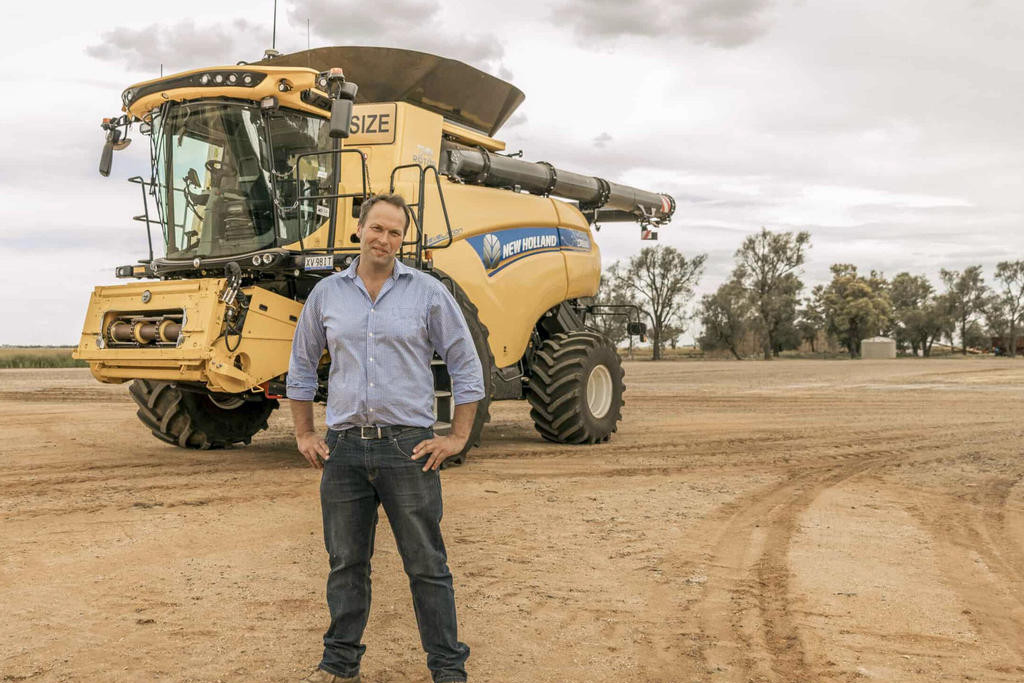
Mr Jochinke was commenting last week in the wake of the NFF's welcome opportunity to participate in the Federal Government's Economic Reform Roundtable to ensure Australian agricultural and regional communities were represented.
"Many areas have received some relief from the persistent dry that we've had it to date with the last weather front that went through," he said.
"It hasn't necessarily solved any of our problems, unfortunately, (but) it's definitely meant that we're in the game in the cropping sense, and in both the pasture and cropping growth.
"It's just really slow with short days and cold nights, it means that the growth that we would've had at the start of the season if it rained, isn't comparable to where we are.
"So I'm hearing of areas being up to seven to eight weeks behind where they usually would be."
With livestock farmers having to continue feeding deep into winter, he said the lack of conditions conducive to fast growth "is going to be so far behind, they're still going to be in a very delicate balance."
But there were some positives.
"Most of the crops are coming out of the ground reasonably well," Mr Jochinke said.
"There is some patchiness, depending on soil type and germination. But overall, they've got some potential to get to average.
"However, the cream, the top end of everything, has gone out of this year purely because of the timing.
"This was so far behind where we usually are, and it's essentially going to come down to what kind of spring we have."
He said "a kind spring" that was "not too cold (and) not too warm" would make "the difference between us having a poor to average year, to having an average to a strong average year."
Mr Jochinke said canola is one type of crop that will likely yield sub-par results this season.
"The cereal has looked to have come up quite evenly, and surprisingly, so has the lentils," he said.
"But they're all very late, and it looks like canola has taken the brunt of the dry spell, depending on if it was sown early, and if it was affected by a split germination with the Anzac Day rain.
"Whatever is going to be there won't have the biomass and then the potential yield that it usually does. We will have a few flowers there, but it won't be a real solid crop north of Horsham."
He said a lot of people held back and didn't sow any canola at all "because of such a late season" and instead deferred to barley, wheat, lentils and hay.
So with decisions by farmers being taken under such challenging conditions, Mr Jochinke said the overall situation highlighted the need for better governance structures in place.
"I think nationally, it demonstrates that we haven't got our drought management set right," he said.
"We need to make sure that farmers have got all the adequate tools they need, which is things like getting the piped network as far as we can to as many areas as we can for water, (and) making sure that we've got investment policy around ensuring farmers build on farm storage so that they can manage multiple years of either grain or hay for their operations, either being a buyer or seller."
He added he felt the government should have "meaningful intervention when a set threshold hits", with low interest loans a key part of that picture, making sure "those loans are of absolute benefit to the agricultural sector, not just by name, but by actual functionality", including being able to defer payments "for a period to allow farmers to get back on their feet".
He said the current approach of the government appears to be a "build it as you fly it" paradigm and "is taxing on everybody".
"Even to the extent of knowing that in drought conditions, we need to move hay interstate, so having either the biosecurity and the paperwork ready to go when that occurs, so we're not having to navigate or build systems into place when there is a call," Mr Jochinke said.
"We know it happens every drought, so how can we ensure that we've got all the framework in place so we can just 'break glass' when we need to, when the threshold occurs, (and) get the trucks rolling in the right directions for either moving stuff around or even moving livestock around."
He said the NFF had been actively working with the Australian government to be at the roundtable.
"We thank the treasurer and the government for ensuring agriculture has a seat at the table," Mr Jochinke said.
"Our inclusion in the session on 'international risks, opportunities and trade' is timely. The global landscape that has long supported our sector through geopolitical stability, strong institutions, and consistent policy is under pressure.
"Given the importance of the regions and agriculture to Australia's exports, it's essential that the NFF has a seat at the table shaping Australia's economic future."
The local agricultural industry's global exposure amounts to over $70 billion of produce exported annually – over 10 per cent of all national exports.
"More broadly, our sector contributes about $90 billion to the national economy and supports about 275,000 jobs," Mr Jochinke said.
"But farming is more than just numbers, it's the backbone of regional Australia, a pillar of national prosperity, and the foundation of global food security."
The NFF's 2030 Roadmap outlines an ambitious goal to grow farmgate output to $100 billion by the end of the decade.
"Economic reform must go hand-in-hand with agricultural growth," Mr Jochinke said.
"Every Australian household relies on our sector daily. We look forward to contributing to this important discussion and ensuring farmers' voices are heard."
Mr Jochinke told The Wimmera Mail-Times the issue of mental health was also a factor that needed increased consideration.
"In droughts, farmers have to make a lot of decisions, and making good decisions is a challenge," he said.
"So just making sure that (with) mental health, people are talking about how they're travelling with their friends and loved ones.
"Hopefully, if they do need help in any scenario that they reach out for financial, mental, social (support) and even advice.
"There's plenty of people have gone through these scenarios, but it is really hard to manage a lot of what we just spoke about.
"It's not for the faint-hearted."
He was grateful for increased awareness of the issue from organisations like the National Centre for Farmer Health and Let's Talk Foundation, and he hoped the government would understand they can play a role in augmenting those resources.
"That's what we said when the prime minister visited the farm over in South Australia," Mr Jochinke said of Anthony Albanese's trip with senior ministers to a drought-affected grain and livestock producer on the Adelaide Plains just over two months ago.
"We didn't expect for him to bring rain with him, but what we did expect from him is to understand and hear those stories, and having those platforms or opportunities is important to share those really painful stories, but also just generally talk, because that unlocks a lot of things and hopefully provides either information for people who need it or a pathway for those people to know that there is a light at the end of every drought, and it's just a matter of navigating your way to get there."