General News
22 October, 2025
‘Weary’ book promotional tour comes to Horsham
PROLIFIC Australian history writer, Peter FitzSimons, will be in Horsham next month as part of a massive 26-day tour to publicise his latest work, this time on the iconic war hero, Sir Edward ‘Weary’ Dunlop.
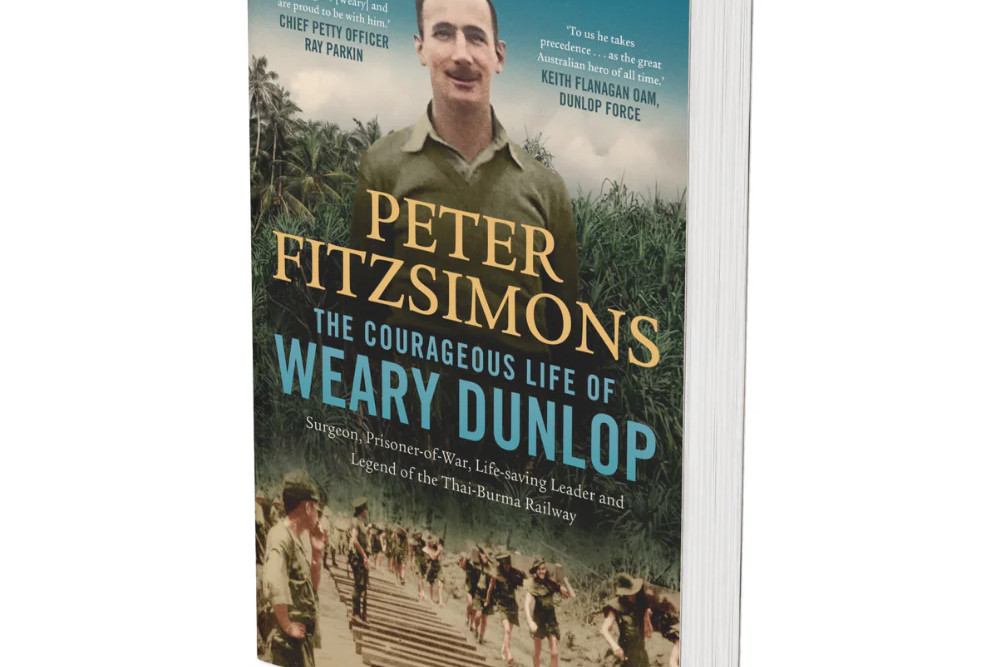
Launching the book next week and covering mostly Victorian locations on the tour, Mr FitzSimons said he was thrilled to release The Courageous Life of Weary Dunlop and tell the story in an engaging page-turning way.
“I do try and take a different approach (with) the books that I do,” he said.
“What I want is for it to read like a novel, so that the reader is immersed in the book and but nevertheless, have it backed up by 1000 footnotes.
“I'm heavy on researchers to find diary entries, find letters, find contemporary accounts, to cross-reference, to work out exactly what happened.”
The work has been a long time coming, with him originally signing the contract to cover Dunlop’s life about 15 years ago.
“Then I realised what a what a process it would be – and delayed it, delayed it, delayed it,” Mr FitzSimons said.
“This time, when I got into it, the best of all possible things happened. I got completely absorbed and said, ‘Wow, what a stunning story is this?’”
He said he felt a closer personal affinity to Dunlop through a common thread of playing rugby for the Wallabies and got to appreciate how imposing a figure he was.
“He was a physical giant of a man – he was six foot four and came off the farm at Benalla,” Mr FitzSimons said.
“He could hold two, 212-pound bags of wheat in either arm.
“I was six foot six when I was in the Wallabies, and I was big for my time. So six foot four in the early 1930s, he must have been Gulliver, and he was just so big and strong.”
Although the narrative does focus predominantly on Dunlop’s life during World War II – especially the Thai Burma Railway – the opening scene starts with a heavyweight brawl with the All Blacks – of which Mr FitzSimons said “I know what that’s like” – and used the immediate press attention he got to weave into the story his background, “his childhood, the kind of man that he was”.
Dunlop won a scholarship to study surgery in England, and subsequently, with the war breaking out, found himself in the Middle East, and then with the railway as the chief medical officer for 3000 Australian POW soldiers.
Mr FitzSimons said an aspect that really spoke to him was Dunlop’s egalitarian approach in the role.
“One of the things fascinated me about Weary is how Australian he was,” he said.
“He says, ‘This is the way we're going to do it. We're going to apply Australian values. All officers will eat exactly the same as all of the soldiers, we’ll share the same tents, we’ll share the same workload, and it will be the strong that look after the weak. It won't be the privates looking after the Colonels.’”
He said the proof was in the results, as across the creek, a British battalion operated according to a class system where the officers got the best food and the best medical care.
Both groups originally had about 600 men, but of “our 600, 550 came home – their 600, 50 came home”.
“Applying Australian values got Australians home,” Mr FitzSimons said.
He said, despite having written about subjects like the Kokoda Track, Ned Kelly, Eureka Stockade and Gallipoli, “this is the most Australian of all Australian books I've done”.
“I don't think we've lost Australian values, but it's a rediscovery,” he said.
“People that have read it just say this is so inspirational.
“Frankly, here is the truth. It makes you proud to be Australian."
Mr FitzSimons added he loved doing a story on another historic Victorian subject.
“They should make me an honorary Victorian for the number of Victorian stories I've done,” he quipped.
“I always love being in Victoria, and so I'm looking forward to being in Horsham.”
The interactive evening will include Mr FitzSimons reflecting on the book’s research, a Q&A session, followed by an opportunity to buy a copy and have it signed by him.
The event will be hosted at the Mibus Centre (Library) in McLachlan St on Monday, November 17, from 6.30-8.30pm; please arrive by 6.15pm.
Tickets are free but limited – please book at wimmeralibraries.vic.gov.au/events/peter-fitzsimons.